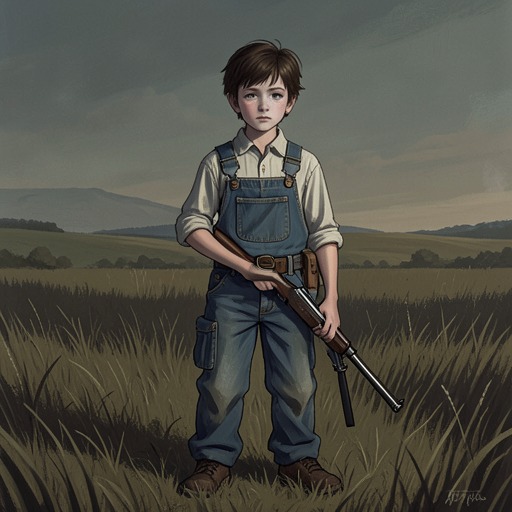
Lars Haug and Odd
Out Stealing HorsesLars Haug and Odd are ten-year-old twins whose relationship is presented through childhood play and imitation before being violently cut short. In a game built around their admiration for their older brother Jon, Lars picks up Jon’s gun and fires it without aiming; the shot strikes Odd in the heart. The death is accidental, but the narrative refuses to soften its consequence: the boys’ shared childhood becomes inseparable from a moment that cannot be undone.
Twin Brothers and Childhood Play
The twins are introduced as Jon’s younger brothers, left at home while he is responsible for them. They have spent the morning playing in the basement with cast-off clothes and worn-out shoes. When they come upstairs laughing, the corridor presents them with two things that can be folded into a game: hares hanging on a peg and Jon’s gun leaning against the wall. Their discovery of the gun belongs first to the ordinary world of children’s play, where an object can become a prop and an older brother’s life can be imitated.
The narration emphasizes that Jon is a hero to both boys. He stands for the kind of daring figures they know from stories, and the narrator describes him as combining the appeal of Davy Crockett, Hartsfoot, and Huckleberry Finn. What matters to Lars and Odd is not a plan to use the weapon for violence; it is the possibility of becoming Jon, even briefly, by holding what he holds. The twins’ shared admiration gives their play its intimacy, but also makes imitation dangerous: the gun carries the reality of an adult weapon into a game that cannot contain its consequences.
The Gun and the Fatal Game
Jon’s gun had been given to him by his father for his twelfth birthday, with strict instructions about what it should and should not be used for. Jon normally unloaded it when he returned home, set it at half cock, and hung it on a high hook in the closet. On this occasion, he left it in the hall without removing the final cartridge. The account establishes this lapse as the immediate circumstance that makes the accident possible, not as evidence that anyone intended harm.
Lars reaches the gun first. He swings it around and calls, “Look at me now!” before pulling the trigger. The recoil knocks him to the floor with a shriek. He has not aimed at a target: he wants to hold the wonderful gun and be Jon. The shot misses the objects around the corridor and strikes Odd at close range, in the heart. The sudden change from performance to death is the defining turn in the brothers’ relationship as it is shown in the book. The game ends in a loss neither child chose, and Lars’s action becomes bound to the death of his twin.
Responsibility, Chance, and Irreversibility
Jon’s position in the episode adds another layer of responsibility. He remembers that the ten-year-old twins are alone at home, realizes that he has failed to make the gun safe, and runs back. As he approaches, he sees his father emerge from the forest and understands that something has already happened. He sinks onto the grass, believing it is too late and fearing what he will find. The episode therefore places the brothers’ accident within a wider family scene: Lars fires, Odd is struck, and Jon confronts the consequences of having left the loaded gun accessible while he was responsible for them.
The narration explicitly resists explaining Odd’s death as fate. It evokes the kind of story in which a name might seem written on a cartridge or in the stars, then rejects that account: no power beyond human control directed the gun. The only book in which Odd’s name is finally recorded is the church registry. That contrast makes the event both contingent and irreversible. The accident need not have been destined in order to become a fact that cannot be recalled or corrected.
Reconstructed Memory and the Brothers’ Ending
The scene reaches the reader through the narrator’s recollection of what his father told him. He acknowledges that his father could not have supplied every detail and that he cannot tell whether he began filling out the scene immediately or over the years. The narrative thus distinguishes between the uncontestable event and the image through which it has endured in memory. Its vivid particulars—the boys laughing as they come upstairs, the gun against the wall, Lars falling, and their father carrying Odd out—belong to a remembered reconstruction, while the fatal shot and its outcome remain the cold facts.
The account does not give the brothers a long history of rivalry or conflict; it shows them together in play, joined by their admiration for Jon, and then separates them through a single accidental shot. The contrast is central to the relationship’s tragic force. Lars means to imitate his brother, not to injure Odd, but intention cannot reverse what happens. The narrator’s final image turns from the house to Jon’s white face and the river, as Jon pushes off and lets the boat drift toward home and those waiting there. Odd’s death enters family memory not as a fated ending but as a human accident whose consequences survive the moment that caused it.